Light, measured.
What red and near-infrared light are, how our systems deliver them, and exactly what they are, and are not, indicated for. No overstatement. Only what can be verified.
Longer wavelengths travel further.
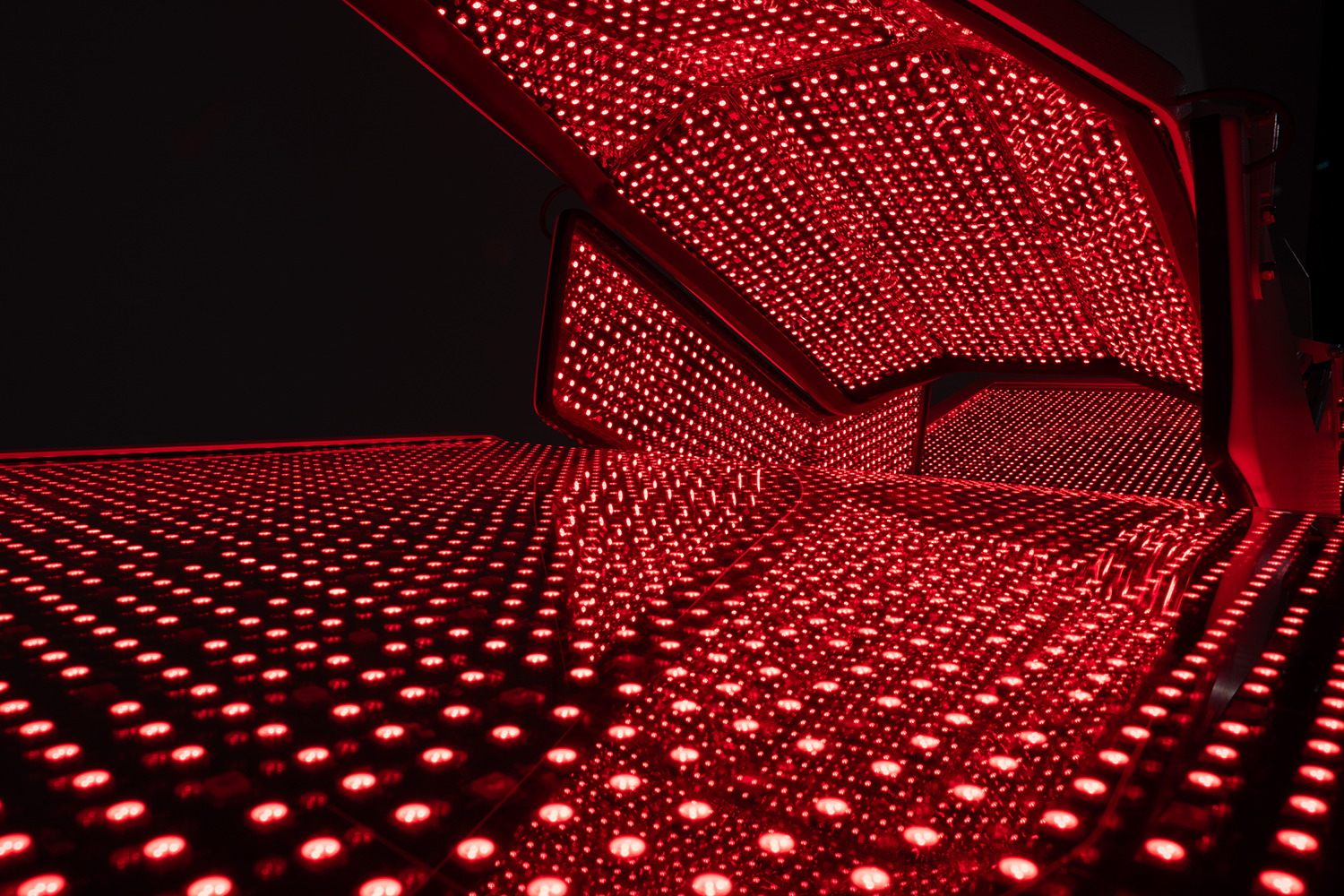
Each color of light is a different wavelength. Shorter wavelengths, like violet, blue and green, are absorbed close to the surface of the skin. Longer wavelengths travel further. Red sits at the long end of the visible spectrum, and near-infrared sits just beyond it, where the eye can no longer see. That is why every Body Balance System uses 635 nm red and 850 nm near-infrared light.
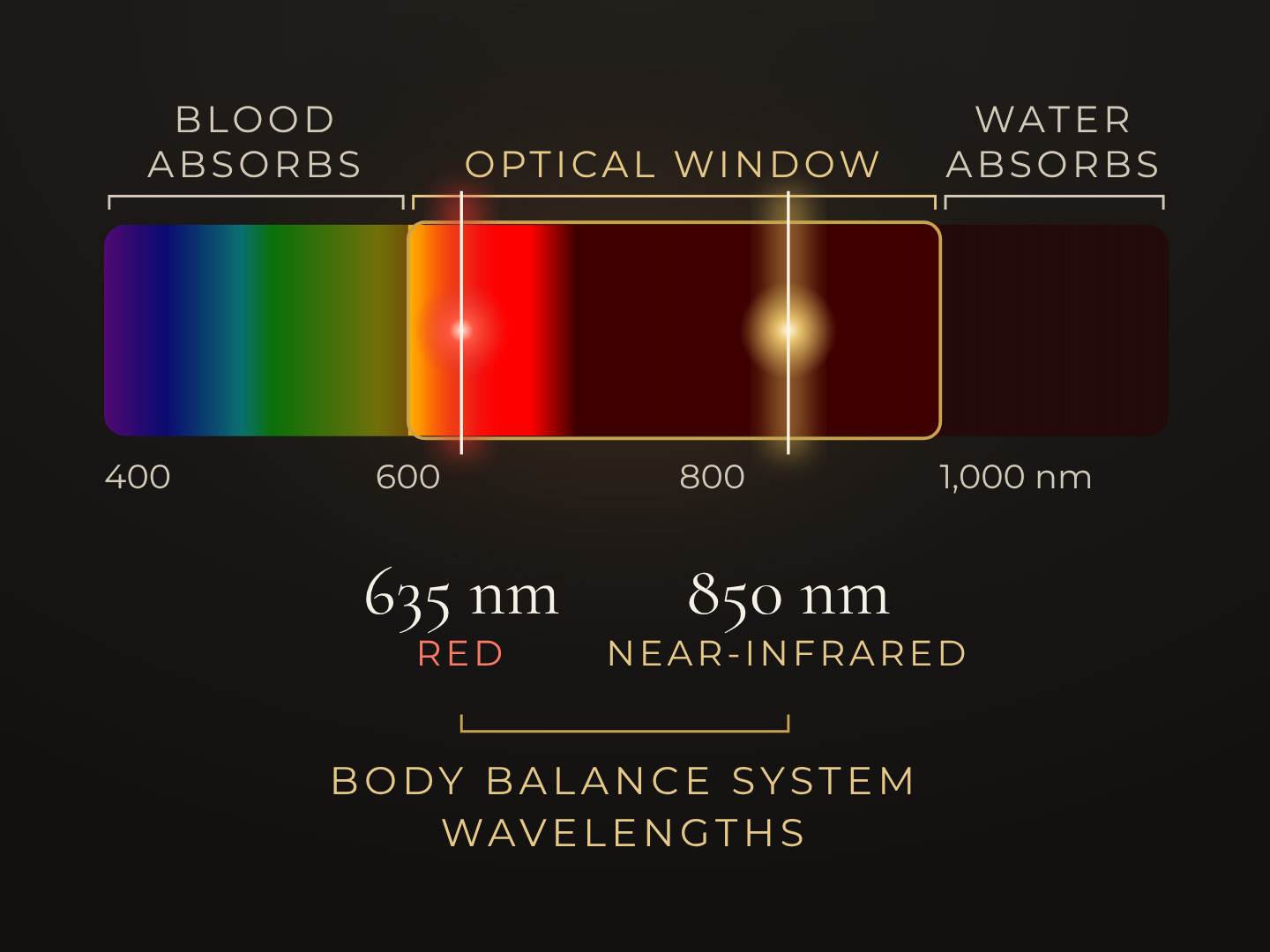
- Blood absorbs: Prahl S. Tabulated molar extinction coefficient for hemoglobin in water (data from Gratzer and Kollias). Oregon Medical Laser Center. Blood shown at 95% oxygen saturation.
- Optical window: Jacques SL. Optical properties of biological tissues: a review. Physics in Medicine and Biology. 2013;58(11):R37-R61.
- Water absorbs: Hale GM, Querry MR. Optical constants of water in the 200 nm to 200 micron wavelength region. Applied Optics. 1973;12:555-563.
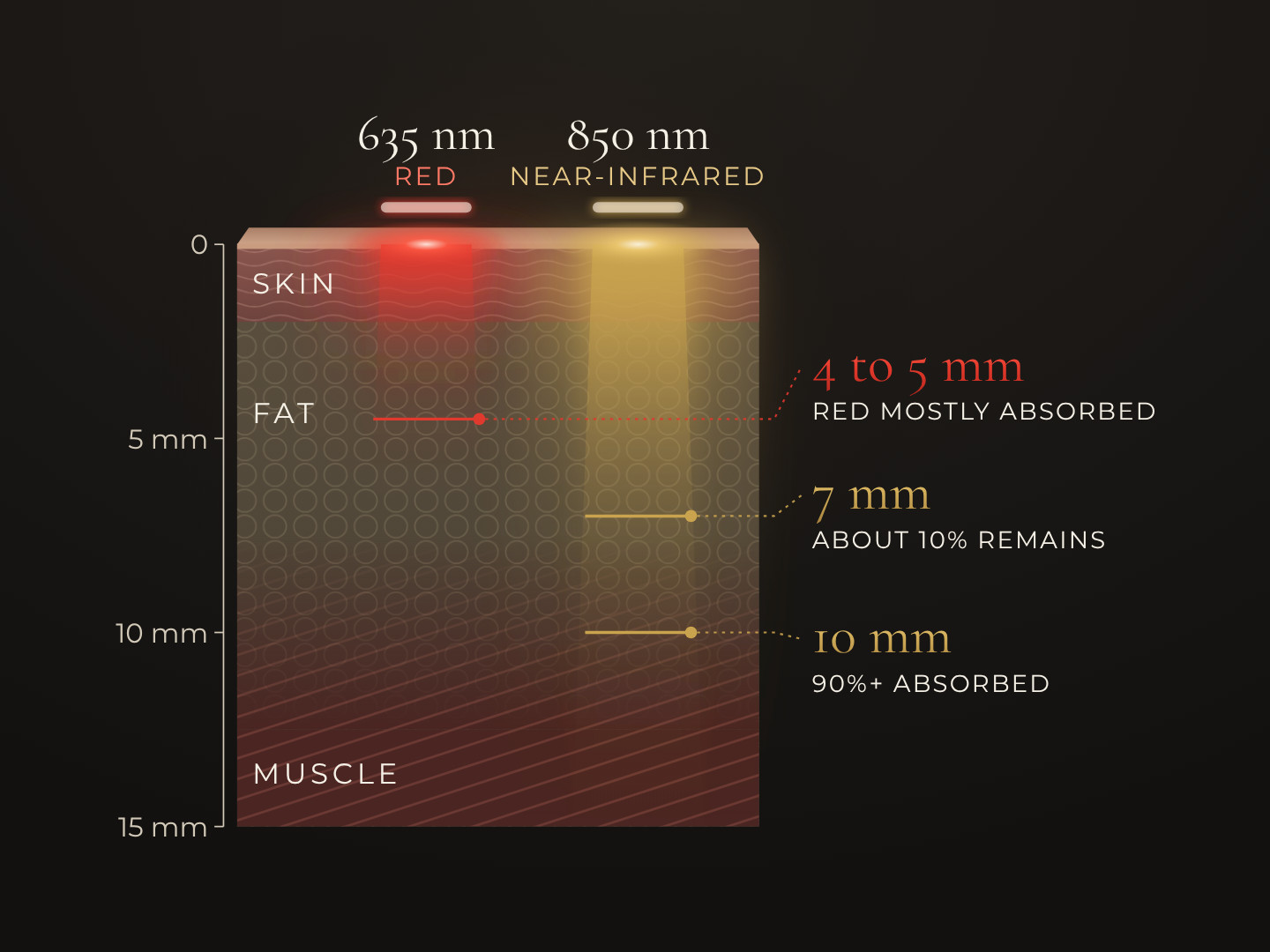
- 4 to 5 mm, red mostly absorbed: Ash C, Dubec M, Donne K, Bashford T. Effect of wavelength and beam width on penetration in light-tissue interaction using computational methods. Lasers in Medical Science. 2017;32(8):1909-1918. Red light values are from this computer model of skin.
- 7 mm, about 10% remains, and 10 mm, 90%+ absorbed: Kaub L, Schmitz C. More than ninety percent of the light energy emitted by near-infrared laser therapy devices used to treat musculoskeletal disorders is absorbed within the first ten millimeters of biological tissue. Biomedicines. 2022;10(12):3204. Near-infrared values were measured in tissue at 800 to 905 nm.
- Skin layer: Wang Y, Tian M, Guo R, Du F, Qiu L, Tang Y. Quantification of normal skin thickness using very high-frequency ultrasound: a clinical study in Chinese adults. Quantitative Imaging in Medicine and Surgery. 2025;15(6):5218-5231.
Two wavelengths, working at different depths.
Red light at 635 nm is absorbed closer to the surface of the skin. Near-infrared light at 850 nm travels further into tissue. Delivered together, full-body, they reach the layers where the indicated effects occur.
Closer to the skin, more light arrives.
Light spreads out as it travels, so the amount that reaches the skin drops quickly with distance. The zero-gravity canopy may rest as close as 0–2 in. from the skin, so more of the light each diode produces reaches your guest. Panels and beds that sit further away deliver less of what they emit.
What we say, and what we don’t.
The wellness industry is full of borrowed claims. We would rather be precise. Here is exactly how our systems are classified, certified and indicated.
FDA-registered Class II medical device
Product code ILY, 21 CFR 890.5500. Registration No. 3010627475. Class II and exempt from 510(k) clearance: FDA clearance or approval is not required for this product code, and we claim neither. Registered manufacturers operate under the FDA’s Quality Management System Regulation and are subject to inspection.
The indications. Nothing more.
Under product code ILY, our systems are indicated for:
- Therapeutic heating
- Temporary relief of minor muscle and joint pain
- Temporary relief of arthritis stiffness and muscle spasms
- Promoting muscle relaxation
- Temporarily increasing local blood circulation
Independently certified
OvationULT is NRTL safety certified to IEC 60601-1 by SGS, a Nationally Recognized Testing Laboratory, and tested to IEC 62471 with a photobiological risk group of Exempt. Irradiance for both systems is verified at the polycarbonate surface and stated with a ±10 mW/cm² tolerance.
The research library.
Peer-reviewed work on red and near-infrared light relevant to the indicated uses. Drawn from the works cited in our clinical research booklet.
Effectiveness of photobiomodulation in reducing pain and disability in patients with knee osteoarthritis: a systematic review with meta-analysis
Photobiomodulation therapy plus usual care is better than usual care alone
Wavelength- and irradiance-dependent changes in intracellular nitric oxide
21 CFR § 890.5500: Infrared lamp
Research is provided for education. Citing a study does not imply any indication beyond those listed above. Read the full clinical research booklet.