Red + near-infrared: what 635 nm and 850 nm do differently
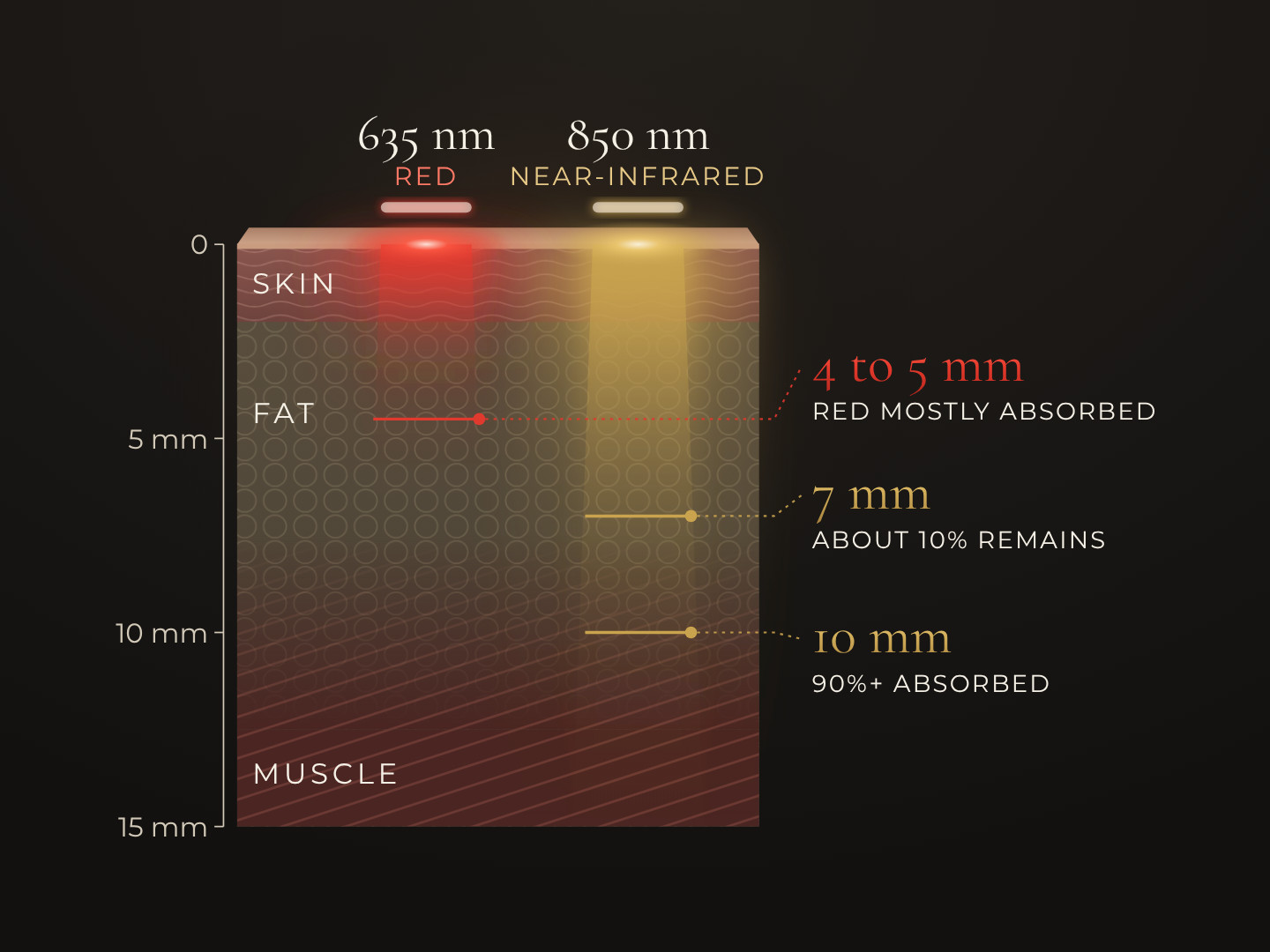
Photobiomodulation research treats wavelength as the single most consequential variable in a light-based session. 635 nm red light and 850 nm near-infrared light reach different depths and interact with tissue through different pathways. For an operator running full-body sessions, that difference shapes session design, what guests experience, and how to read an equipment spec sheet.
What 635 nm red light does
The 635 nm wavelength sits near the peak of the visible red spectrum, inside the “optical window” of biological tissue. A widely cited review by Hamblin and de Freitas describes cytochrome c oxidase, the terminal enzyme in the mitochondrial electron transport chain, absorbing light across the red and near-infrared bands, with particular sensitivity around 620 to 680 nm. The leading hypothesis is that photon absorption dissociates inhibitory nitric oxide from the enzyme, restoring electron transport and increasing ATP production at the cellular level.
Reported penetration at 635 nm is roughly 1 to 2 mm into skin and superficial tissue. That makes it relevant to targets near the surface: dermal fibroblasts, keratinocytes, superficial capillary beds and epidermal structures. A 2024 review in the International Journal of Molecular Sciences found that red-band photobiomodulation stimulates chromophores involved in local circulation pathways.
In practice, 635 nm addresses the outermost physiological targets in a full-body session. Its depth profile is predictable and well characterized, which makes dosimetry easier to manage at this wavelength than at longer ones.
What 850 nm near-infrared does differently
850 nm falls in the near-infrared band, outside visible perception, and behaves fundamentally differently in tissue. Longer wavelengths scatter less and penetrate deeper; reported penetration for 850 nm ranges from roughly 3 to 5 cm in soft tissue under standardized conditions, depending on composition, hydration and anatomical site. A review in Photobiomodulation, Photomedicine, and Laser Surgery confirmed that near-infrared wavelengths consistently outperform visible red for reaching deeper structures.
The primary absorption target is still cytochrome c oxidase, but 850 nm reaches tissue layers that 635 nm cannot. Hamblin’s 2018 review in Photochemistry and Photobiology describes near-infrared photobiomodulation acting on mitochondria in deeper musculoskeletal tissue, with implications for joint capsules, tendons and deeper muscle groups. The biphasic nature of the cellular response matters especially here: beneficial effects depend on an adequate but not excessive dose at the target, and overdosing the surface risks underdelivering at depth.
For a commercial system, 850 nm extends a session’s reach beyond the skin. Operators serving guests with musculoskeletal or joint-related goals should treat 850 nm coverage as distinct from 635 nm coverage, not interchangeable with it.
Why penetration depth matters for full-body sessions
Depth determines which anatomical targets a session can plausibly reach, and that determines what a device can support. A system emitting only 635 nm addresses superficial targets with precision but cannot reach joint capsules, synovial tissue or deeper muscle bellies. A system emitting only 850 nm risks overdosing superficial structures while trying to deliver an appropriate dose at depth.
Published dosimetry frames the task as matching wavelength to target depth. Each wavelength has a therapeutic window: energy above it inhibits cellular response, energy below it fails to elicit one. For an operator running two or three guests per hour, wavelength selection is the primary lever for determining which tissue layers receive a therapeutic-range dose within a fixed session.
Combining 635 nm and 850 nm in a single session has become the standard commercial approach because it covers both strata at once. The literature treats the two as complementary rather than interchangeable. Dual-wavelength coverage is a baseline specification, not an upgrade.
The biphasic dose-response curve
Also called the Arndt-Schulz curve, the biphasic dose-response describes a fundamental property of photobiomodulation: at low doses cellular stimulation increases, but at higher doses the same tissue can become inhibited or return to baseline. A 2009 study by Huang, Chen, Carroll and Hamblin in Dose-Response first formally characterized the pattern, and subsequent updates confirmed it across tissue types and irradiance levels.
The practical consequence: higher irradiance and longer sessions are not automatically better. Each tissue type has an optimal dose range measured in joules per square centimetre, and exceeding it produces diminishing or counterproductive results. Irradiance and duration have to be specified together.
Because irradiance is inseparable from time, a device with higher irradiance can deliver the same dose in a shorter session, which directly improves throughput. The curve also explains the emphasis on precision: the gap between a stimulatory and an inhibitory dose can be smaller than operators expect.
How irradiance connects to throughput
Irradiance, in milliwatts per square centimetre, is the rate at which light energy reaches the tissue surface. It is distinct from total dose, which also incorporates time. In commercial operation, irradiance determines how quickly a therapeutic-range dose accumulates within a fixed session window.
The OvationULT operates at 65 mW/cm² (±10 mW/cm²), measured at the polycarbonate surface. At that specification a guest accumulates a meaningful dose within 10 to 20 minutes, the window consistent with published full-body protocols, and a standard two-guests-per-hour model is achievable without compromising dose delivery. At substantially lower irradiance, either sessions extend past commercially viable lengths or guests receive a sub-therapeutic dose.
When comparing systems, always read irradiance alongside recommended session length. A device claiming short sessions while listing low irradiance presents parameters that do not align with the dose literature.
Why commercial protocols use both together
The rationale is comprehensive depth coverage, from skin surface to deep musculoskeletal tissue. Karu noted in 2014 that multiple wavelengths act on both mitochondrial and non-mitochondrial photoacceptors, and that tissue heterogeneity across the body means no single wavelength uniformly addresses every target in a full-body session. Guests with skin-focused goals draw primarily on 635 nm; guests with musculoskeletal goals draw on 850 nm; most benefit from both simultaneously.
The OvationULT emits both 635 nm red and 850 nm near-infrared in a single session. It is an FDA-registered Class II medical device (Registration No. 3010627475, product code ILY). Registered indications are topical heating, temporary relief of minor muscle and joint pain and stiffness, temporary relief of minor arthritis pain, relaxation of muscle spasm, and temporary increase of local circulation.
635 nm vs 850 nm at a glance
| Feature | 635 nm (red) | 850 nm (near-infrared) |
|---|---|---|
| Tissue penetration (reported) | ~1 to 2 mm | ~3 to 5 cm |
| Primary chromophore | Cytochrome c oxidase (red band) | Cytochrome c oxidase (NIR band) |
| Primary tissue targets | Skin, epidermis, superficial capillaries | Deep muscle, joints, tendons |
| Visibility | Visible red | Invisible to the naked eye |
| Dose consideration | Lower scatter; predictable surface dose | Greater scatter correction needed for depth |
| Commercial role | Superficial target coverage | Deep-tissue target coverage |
Questions operators ask
What is the difference between 635 nm and 850 nm in the research?
635 nm red light penetrates roughly 1 to 2 mm and acts primarily on superficial structures. 850 nm near-infrared penetrates roughly 3 to 5 cm, reaching deeper musculoskeletal tissue, joints and tendons. Both target cytochrome c oxidase in the mitochondrial respiratory chain; their anatomical reach differs significantly.
Why does the wavelength specification matter when choosing a system?
Wavelength determines where in the body light energy is absorbed. A single-wavelength system addresses a single depth range. A system emitting both 635 nm and 850 nm addresses the full range from skin surface to deep tissue in one session, which matters for a general clientele with varied goals.
What does “biphasic dose-response” mean for an operator?
Cellular stimulation increases with dose up to an optimal point, then declines or reverses. Longer sessions at high irradiance are not categorically better than properly calibrated shorter ones. The OvationULT’s 65 mW/cm² (±10) paired with 10-, 15- or 20-minute sessions is designed to land within the published stimulatory range.
Is the OvationULT FDA registered?
Yes. Registration No. 3010627475, as a Class II medical device under product code ILY, which is exempt from 510(k) clearance. Registration is an administrative filing; FDA clearance or approval is not required for an ILY device, and Body Balance System claims neither. Registered manufacturers operate under the FDA’s Quality Management System Regulation and are subject to inspection.
How does 65 mW/cm² affect session length and throughput?
At 65 mW/cm² (±10) the OvationULT accumulates dose quickly enough to reach the published therapeutic range within its 10-, 15- or 20-minute presets. With the required 10-minute cooldown between guests, that supports up to three guests per hour at the 10-minute setting and two at 15 minutes. Lower-irradiance systems need longer sessions to reach an equivalent dose, which reduces throughput and creates scheduling constraints.
- Hamblin MR, de Freitas LF. Proposed Mechanisms of Photobiomodulation or Low-Level Light Therapy. IEEE J Sel Top Quantum Electron, 2016. PMC5215870
- Hamblin MR. Mechanisms and Mitochondrial Redox Signaling in Photobiomodulation. Photochem Photobiol, 2018. PMC5844808
- Huang YY, Chen AC, Carroll JD, Hamblin MR. Biphasic Dose Response in Low Level Light Therapy. Dose-Response, 2009. PMC2790317
- Karu TI. Cellular and Molecular Mechanisms of Photobiomodulation. IEEE J Sel Top Quantum Electron, 2014. DOI 10.1109/JSTQE.2013.2273411
- Naharro-Rodriguez J, et al. Unlocking the Power of Light on the Skin: A Comprehensive Review on Photobiomodulation. Int J Mol Sci, 2024. PMC11049838
See both wavelengths in a session
Visit us in Las Vegas, book a session at a client property near you, or meet us at an industry event.
Request a consultationBody Balance System red light therapy systems are FDA-registered Class II medical devices (Reg. No. 3010627475, product code ILY, 21 CFR 890.5500) for therapeutic heating and the temporary relief of minor muscle and joint pain, arthritis stiffness and muscle spasms, promoting muscle relaxation and temporarily increasing local blood circulation. FDA establishment registration and device listing are administrative filings and do not denote FDA approval, clearance, endorsement or evaluation. Research cited describes the photobiomodulation literature generally and is not a claim about any specific device.